Expert as a Service beats Software as a Service

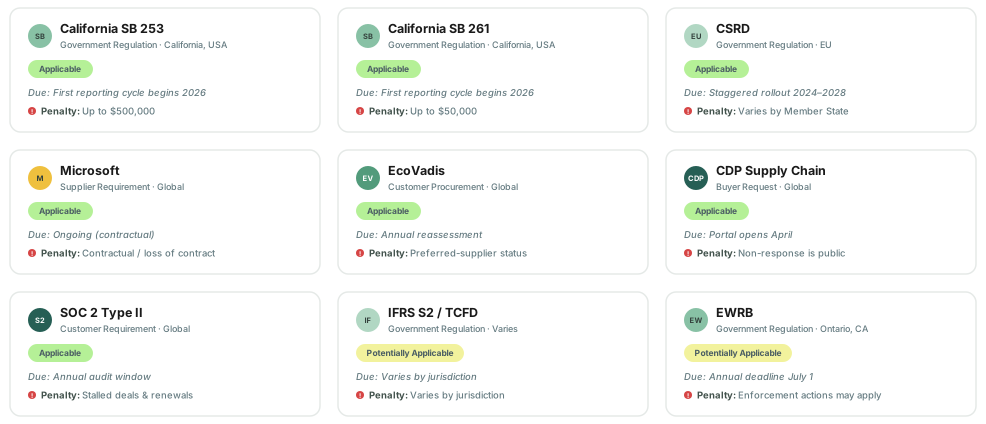
Your mid-market company is spending $42,300 annually on sustainability reporting — and you probably don’t even know it. That’s 564 internal hours spread across Finance pulling data, Operations translating formats, and management reviewing compliance requests from EcoVadis, CDP, and increasingly, clients requiring carbon accounting under regulations like California’s SB 253.

The hidden labor cost exists because sustainability reporting software solves the wrong problem. These platforms automate report generation when the real bottleneck is expertise — knowing which energy data maps to Scope 2 emissions, understanding why manufacturing costs don’t align with carbon calculations, or interpreting whether supplier assessments actually meet what frameworks require.

This expertise gap is why companies end up with multiple sustainability software platforms but still can’t produce consistent reports. More dashboards create more complexity, not less.

WHEN DATA BECOMES LIABILITY

The trust problem sustainability reporting software can’t solve

Your supplier sustainability scores are now part of your customers’ regulatory compliance. Under CSRD, enterprise clients must report supply chain emissions. SBTi targets require them to track supplier progress. You’re not just a vendor anymore — you’re a compliance requirement.

When stakes are regulatory compliance, trust becomes everything. Your clients don’t just need data — they need defensible data they can stake their regulatory compliance on. A wrong carbon calculation doesn’t just look bad; it creates regulatory exposure for your client.

Consider what happened to one 300-person manufacturing company facing an EcoVadis assessment with a 30-day deadline.

  • Their sustainability lead spent six hours trying to figure out which environmental certifications counted for scoring.
  • Day 7: energy data wouldn’t match EcoVadis requirements, with the platform flagging “data inconsistencies” but not explaining what that meant.
  • Day 14: panic mode.

The breakthrough came with expert guidance — someone who could identify the three data gaps that actually mattered for scoring and show exactly how to translate facility energy bills into the format EcoVadis expected. Not generic help documentation or chatbot responses. Specific guidance for their specific business. Result: a 67/100 score, well above the client’s 45-point threshold.

JUDGMENT VS. AUTOMATION

Why the AI-everything approach fails

The AI-for-everything crowd is about to learn a hard lesson about sustainability compliance. Large language models excel at pattern recognition but struggle with regulatory interpretation. ChatGPT can write a carbon footprint report that sounds perfect but cannot tell you whether that report will satisfy EcoVadis assessors, SBTi reviewers, and CSRD auditors simultaneously.

These frameworks define materiality differently, use different calculation methodologies, and require different evidence standards. The knowledge required to navigate these differences isn’t in any training dataset — it’s earned through hundreds of compliance cycles and years of regulatory changes.

One client nearly lost a $2 million contract because their “automated” carbon calculation was off by 300%.

The software worked perfectly, calculating emissions based on data inputs. The problem: facilities tracked billed usage with a three-month lag, not actual usage. Grid factors were from 2019, not 2023. They used location-based factors when the client needed market-based calculations for SBTi reporting.

Automation handles mechanics — calculations, formatting, and data processing. Expertise handles judgment calls — context, interpretation, and “does this actually make sense?”

THE HIDDEN COST

The fragmentation tax

Companies collect the same underlying data 15-30 times annually in different formats for different requestors. This represents the fragmentation tax: hundreds of hours of internal labor because platforms don’t talk to each other and nobody has expertise in translating between frameworks.

Analysis of 200+ mid-market companies shows an average of 47 hours monthly on sustainability reporting.

Finance pulls data for 8-12 hours, Operations translates for another 15, and management reviews and reformats for 20+ more. At a blended rate of $75 an hour, that’s $42,300 in hidden labor costs annually — for work that doesn’t generate revenue.

Most CFOs have no idea this number exists because it’s spread across departments as “other duties as assigned.”

THE HYBRID MODEL

Expert as a service changes the economics

Expert as a service acknowledges what the AI crowd won’t: compliance is ultimately about judgment, context, and professional accountability. Software executes. Experts decide what to execute.

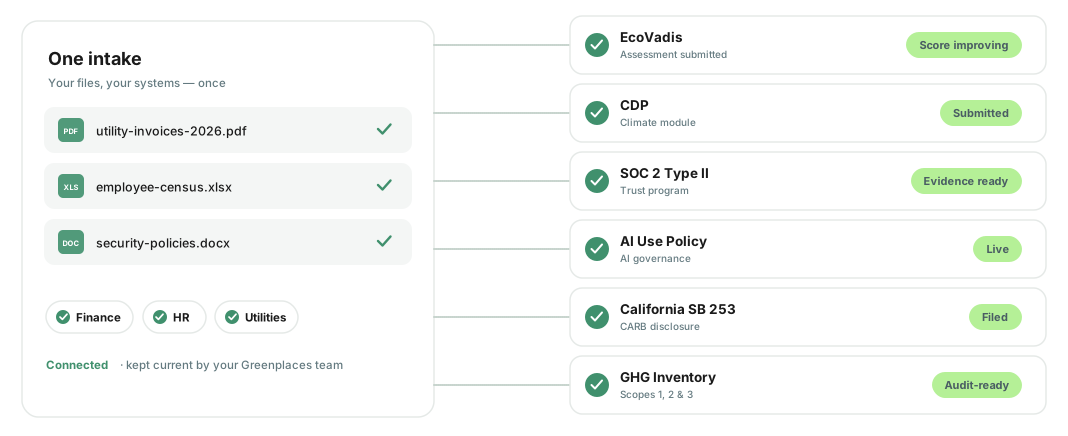
The model pairs credentialed experts who understand all frameworks with a platform that handles all formats. One expert who’s guided CSRD readiness 50 times, not software that promises to figure it out for you. The expertise you don’t have plus the platform efficiency you need.

This approach cuts hidden labor costs by 60% while reducing customer compliance risk. ROI typically hits 18 months before calculating the value of not losing a major client over missing sustainability scores.

LOOKING AHEAD

The stakes keep rising

Regulatory penalties are getting bigger. Tolerance for errors is getting smaller. When your GRC framework depends on supplier compliance data, you don’t need faster wrong answers — you need right answers the first time.

The gap between inheriting sustainability responsibility and becoming confident isn’t closed by better dashboards. It’s closed by having someone who’s done this before, walking through your specific situation. When your biggest client relationships hang in the balance, that distinction matters more than any feature comparison.

Sustainability compliance has shifted from episodic to continuous. New regulations quarterly, customers adding requirements mid-contract, and frameworks evolving. Infrastructure that adapts isn’t nice-to-have — it’s the only approach that works over time. Learn how Greenplaces combines expert guidance with platform efficiency to help mid-market companies navigate this complexity without building internal sustainability teams.

Make it real

What to do next

If you are the person inside a mid-market company quietly absorbing sustainability reporting on top of your actual job, the most useful thing you can do this quarter is put the hidden cost on paper.

  • Pull a simple tally: How many hours across Finance, Operations, and your own calendar went into EcoVadis, CDP, SBTi, and client questionnaires over the last twelve months — then multiply by a blended hourly rate. That single number is the business case.
  • Pair it with one near-miss story (A delayed filing, a supplier score that almost cost a renewal, a carbon calculation that didn’t match a client’s expectations) and you have a CFO conversation, not a budget ask.
  • Now the decision isn’t software vs. no software — it’s whether your next layer of investment is another dashboard or expertise that makes the dashboards you already own actually usable.
Report with confidence

Contact Greenplaces today for a demo and discover how we can streamline your reporting journey.

Frequently asked questions

Expert as a service pairs credentialed sustainability professionals with a reporting platform, so you get judgment and interpretation alongside automation. Instead of relying on software to infer how EcoVadis, CDP, CSRD, and SBTi frameworks relate to your data, a sustainability expert makes those calls for you and stands behind them.

Analysis of more than 200 mid-market companies puts the average at roughly 47 hours per month, or 564 hours per year, split across Finance, Operations, and management. At a blended $75-an-hour internal rate, that lands at $42,300 annually in hidden labor — almost always spread across departments as “other duties as assigned” and invisible to the CFO.

AI handles the mechanics — formatting, calculations, and data processing — reasonably well. What it cannot do reliably is regulatory interpretation, because frameworks like EcoVadis, SBTi, and CSRD define materiality, calculation methodologies, and evidence standards differently, and those distinctions aren’t in any training dataset. Treating AI as a drafting assistant is fine; treating it as your compliance decision-maker is how companies end up with reports that fail assessor review.

Most platforms are built to generate reports, not to translate between frameworks. Companies end up collecting the same underlying data 15 to 30 times a year in different formats for different requestors — what’s often called the fragmentation tax. Without someone on the team who understands how one framework’s Scope 2 number maps to another’s supplier disclosure, more dashboards create more complexity, not less.

Software alone works when your reporting scope is narrow, your frameworks are stable, and you have in-house experts who already know how to interpret the output. Expert-as-a-service makes sense when sustainability responsibility has been bolted onto an existing role, when your customer base is asking for multiple scores against multiple frameworks, or when a wrong answer carries real regulatory or commercial risk.

Companies typically see a 60% reduction in hidden sustainability labor costs, with ROI landing around the 18-month mark. That calculation does not include the avoided cost of losing a major customer over a missed score or a defensibility failure — which, for most mid-market companies, is the number that actually moves the decision.

Alex Lassiter is the Founder and CEO of Raleigh-based Greenplaces, a platform to make achieving sustainability easy for all businesses. Prior to Greenplaces, Alex co-founded Gather, an enterprise software startup serving the hospitality industry that was acquired by General Atlantic for $500M. Alex was a Morehead-Cain Scholar at the University of North Carolina. He’s an active venture investor, lecturer and advisor to software companies.