Every sustainability framework your customers ask for, managed for you.
EcoVadis, CDP, SBTi, California SB 253, GRI, SASB/ISSB, GRESB, B Corp. One team. One dataset. One engagement at a fraction of consulting cost.
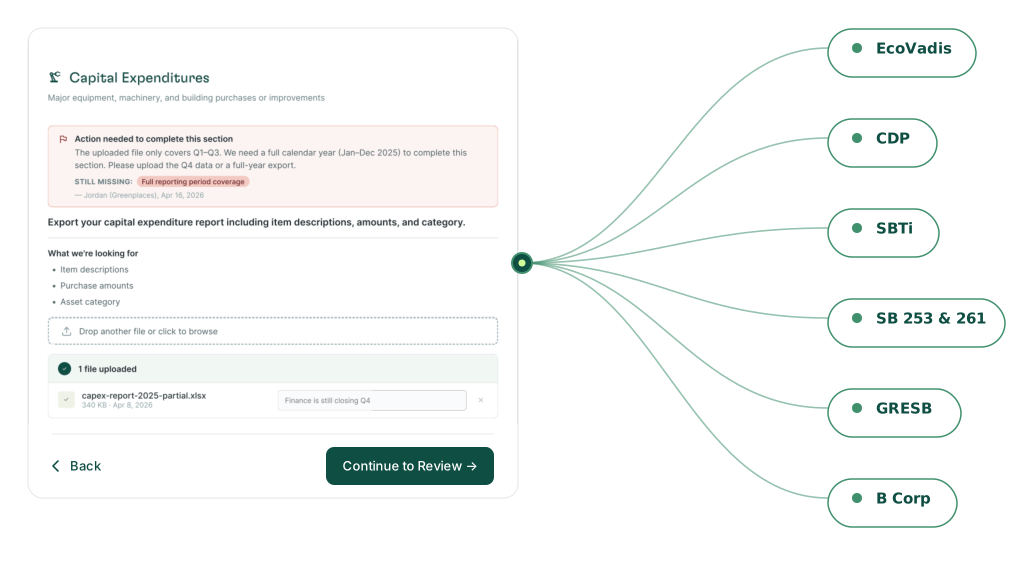
Audit-ready results, in weeks, not quarters. A fraction of the cost of traditional consulting. The same senior team handling every framework your customers, investors, and regulators ask of you, with your data carried forward from one requirement to the next.
Many sustainability clients also face trust and security requirements, we manage both from one engagement.
Sound familiar?
The compliance gap hits mid-market companies the hardest.
Requirements keep growing
Your largest customers keep adding requirements across sustainability, ESG, information security, and AI governance, and the list only grows.
No experts on staff
You don't have compliance experts on staff, and hiring for every framework isn't realistic.
Revenue at risk
Low supplier risk scores are stalling deals and putting real revenue on the line.
Consultants are expensive
Consultants cost a fortune, with unpredictable hourly rates and duplicated work across engagements.
Data collection drains your team
Gathering the data these frameworks demand pulls your team off the work that grows the business.
Software alone isn't strategy
Software alone leaves you to figure out your own strategy: which frameworks matter and how to prioritize them.
If that's you, that's the gap we close.
One platform, every compliance, expert-verified.
Your strategic partner, not just a reporting tool
Beyond the reports, we're your strategic partner. Greenplaces doesn't just hand you a deliverable and walk away. Our experts help you engage your suppliers, prioritize what matters, and turn compliance into a plan that moves your business forward.
From scorecards to regulatory filings.
Each framework has its own methodology, its own deadlines, its own scoring quirks. Our team has been through all of them, repeatedly. We bring the playbook so you don’t have to build one.
EcoVadis
From first submission to a Gold medal. We handle assessment prep, documentation, submission, and cycle-over-cycle improvement.
CDP
Climate, water, and forest disclosures, managed by experts who know exactly what scorers reward.
SBTi target validation
Set science-aligned targets, build the inventory to back them, and get through validation without months of back-and-forth.
California SB 253 & SB 261
CARB-ready emissions disclosures and climate-related financial risk reports for any business doing business in California.
Carbon accounting
Scope 1, 2, and 3 emissions inventory aligned to the GHG Protocol, the foundation that powers every other framework.
GRI, SASB/ISSB, GRESB, B Corp
Specialized frameworks for specific industries and certifications, handled by the same team, from the same dataset.
One foundation. Every framework.
The data and policies you build for one framework are the same that feed the next. We architect the foundation correctly the first time so each new ask gets faster, not harder.
Map the asks you’re facing
Customer questionnaires, regulatory deadlines, certifications you want. We map every commercial and compliance touchpoint and sequence them.
Build the data foundation
Emissions inventory, policy documentation, KPI tracking, evidence pack. Done once, structured to feed every framework on your map.
From submission to strategy
Everything you need to build on your program, hit your targets, and keep improving, with experts guiding the plan, not just the paperwork.
The annual reporting period is a concise deadline and the combination of the GP platform and supporting team has allowed us to efficiently collect data, generate our footprint, and fulfill our reporting obligations. The partnership has made this critical initiative seamless.
Map every framework you face in 30 minutes.
Bring the customer requests, the regulatory deadlines, the certifications you’re chasing. We’ll map them and propose a path. No cost, no commitment.