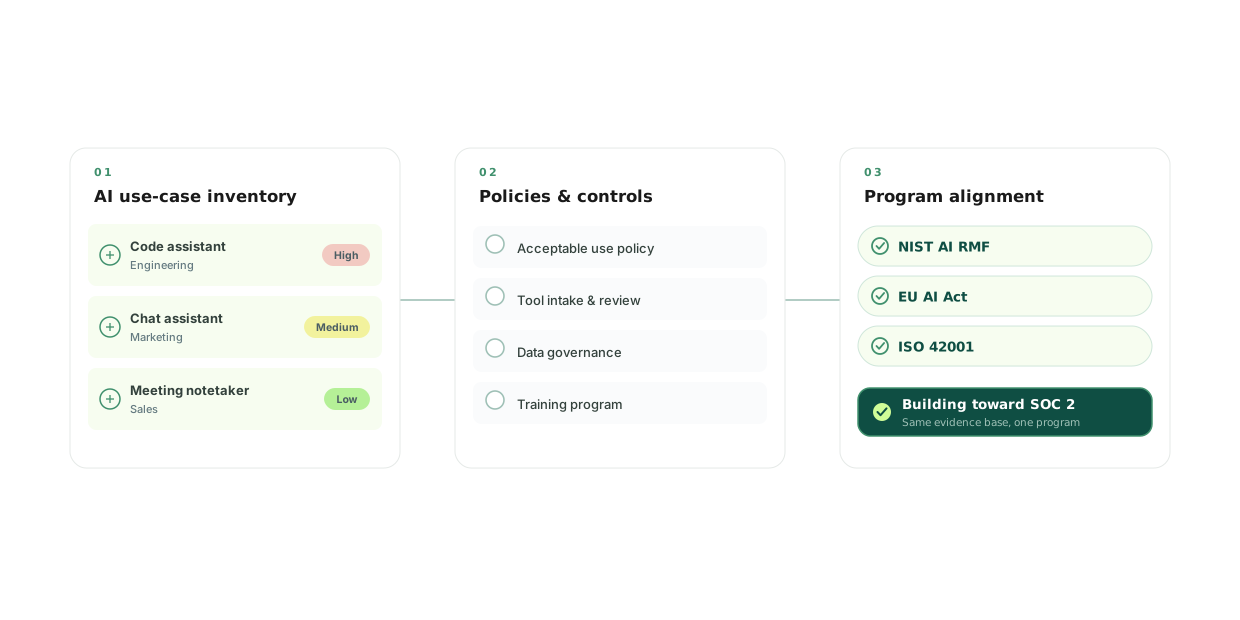
Responsible AI covers two areas, governing how it’s used and accounting for its footprint. Greenplaces works across both.

“Responsible AI” is on every client’s mind right now, and almost everyone means something a little different by it. At Greenplaces, we think responsible AI comes down to two connected priorities. One is governance: deciding which tools are approved and how a company keeps oversight of where AI shows up in the work. The other is footprint: understanding what that AI use costs the environment and accounting for it the way you’d account for the rest of your emissions. Most companies treat these as separate problems for separate teams. We think they belong together.

Governance is the foundation

Any company adopting AI needs clear guardrails. Someone has to decide which tools are approved and for what, who’s allowed to use them, and how the business stays accountable for what the AI produces. A mature AI governance program creates structure around those decisions. It keeps a register of approved tools, runs an intake process for new use cases so nothing gets adopted in the shadows, sets the level of human oversight each use calls for, and gives a named committee, usually with Legal in the room, the job of vetting providers and keeping the policy current. That work earns its keep on security and compliance grounds alone, well before the environmental question ever comes up.

Provider selection sits here too. A vendor is worth weighing not only on functionality, but also on transparency around security, privacy, model performance, and increasingly, energy consumption and emissions reporting. A governance program is the place that criterion gets set and enforced, which is one of the quieter ways the two halves of responsible AI start to touch.

Governance decisions shape AI’s footprint

This is where the two areas begin to overlap. One of the most significant factors influencing AI’s environmental impact is something companies already control: which models employees use for which tasks. That turns out to be the biggest lever on AI’s energy use. Not every request requires the largest, most compute-intensive model available. Simple drafting, summarization, or classification tasks can often be completed by smaller, more efficient models. More advanced reasoning can be reserved for situations where it’s actually needed. The difference matters. Larger models require far more computational resources, meaning more energy consumption for every prompt.

This doesn’t take a separate sustainability initiative, just thoughtful governance. When approved models are matched to appropriate use cases, efficient defaults become part of the governance program rather than an afterthought. Pair that with employee training, and teams naturally manage AI consumption more efficiently without sacrificing productivity. One governance decision does two jobs at once, managing operational risk and environmental impact together.

Measuring AI’s environmental impact

The next question is usually the harder one: How do we actually measure AI’s footprint?
The industry is still working this out. Today, few AI providers publish detailed energy or emissions data at the customer level. Some usage metrics are available, but standardized reporting is still developing. That’s no reason to wait. Just as companies estimate other categories of emissions where perfect data isn’t available, AI can be measured directionally using available usage information and evolving industry methods. For most companies today, AI is still a small part of the total emissions picture. Usage is climbing fast, though, so setting a baseline now beats waiting until reporting expectations catch up. As with every other emissions category, the goal stays the same: measure what you can, manage what you can, and offset only what’s left.

What the standards say

International standards are reinforcing this connected view of responsible AI. ISO/IEC 42001 provides the management framework for governing AI systems, helping a business set policy, oversight, and accountability. ISO/IEC 42005 guides a company through assessing an AI system’s impacts across multiple dimensions, naming environmental impact alongside privacy, fairness, transparency, and accountability. Additional guidance, including ISO/IEC TR 20226, continues building a framework for evaluating AI’s environmental footprint throughout its lifecycle. Taken together, these standards signal where the market is heading: responsible AI isn’t just about governance, and it isn’t just about sustainability. It’s both.

Looking ahead

Responsible AI isn’t two separate conversations. It’s one strategy that combines governance with environmental accountability. Strong governance helps a business manage security, compliance, and operational risk, and it shapes how AI actually gets used day to day. Those same decisions often become the biggest driver of AI’s environmental footprint.

At Greenplaces, we believe no company should have to choose between governing AI responsibly and understanding its impact. The two reinforce one another, and the companies that build both capabilities together will be better prepared as expectations, regulations, and reporting requirements continue to evolve.

Amanda Grady is Solutions Lead for Trust Services at GreenPlaces. She brings over a decade of experience in the technology assurance space at a Big 4 accounting firm, where she helped organizations build and prove out their internal IT controls. She holds a degree in Information Systems Management. Whether the work is SOC 2 readiness, ISO 27001 certification, or AI governance, Amanda’s focus stays the same: building programs that hold up to real scrutiny.

Most providers handle one side of this. Greenplaces works across both. If you’d like to see what that looks like for your team, let’s talk.