Consumer Impact 2026
Greenplaces sponsored Consumer Impact Summit 2026 in Bentonville, where Corinne Hanson spoke on the 2027 regulatory outlook.
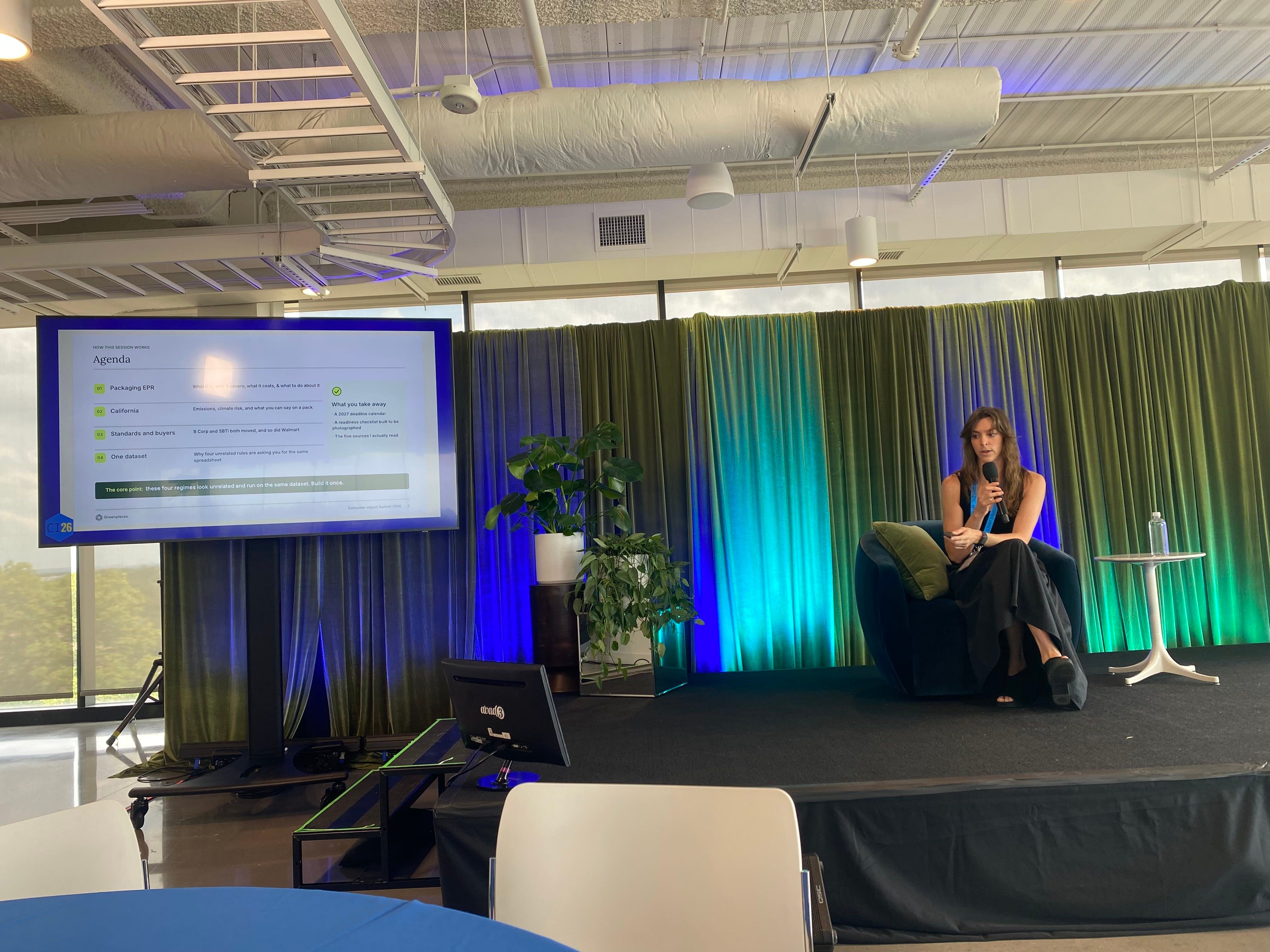
Recap & highlights
The regulatory picture for consumer brands is messy right now. Extended producer responsibility laws for packaging are live in six US states, with California, Colorado, Oregon, Washington, Minnesota, and Maryland now requiring brands to register, report what they put on the market, and pay fees based on material. Canada and the EU are further along. California's climate disclosure laws are partly in effect and partly tied up in court, the B Corp and SBTi standards have both been rewritten, new rules on green claims took effect in the EU this month, and the big retailers keep changing what they ask of suppliers. Deadlines move every month.
Corinne spoke about how to operate inside that without a compliance department. EPR got the most attention because it is the one rule on the list that sends an invoice, and because it catches brands off guard: the obligation lands on whoever's name is on the package, registration often comes years before the first fee, and the fee depends far more on what the packaging is made of than how much it weighs. The first consolidated reporting cycle closed this spring, and plenty of brands either over-reported or had filings rejected for thin methodology.
Her broader point was that most brands chase every deadline, which is exhausting and usually unnecessary. Many of these rules do not reach a company of a given size, and the ones that do tend to run on the same underlying data. Confirm which rules apply, then build the evidence once. A single, well-kept record of what you put on the market, what it is made of, and what you claim about it covers EPR fees, emissions reporting, retailer scorecards, and claims rules at the same time.
She also made the case that the pressure on small brands arrives from buyers before it arrives from regulators. Walmart, Target, Costco, and Amazon are asking for sustainability data as a condition of doing business, often years ahead of any statute, so the retailer questionnaire is the deadline that matters. And she flagged claims as the one area with no size threshold at all. Rules on what you can say about a product, from "recyclable" to "carbon neutral," apply to everyone, and private lawsuits do not wait for enforcement.
The conversation afterward matched what we hear from our own customers. Nobody is short on alerts. What they need is someone to say which of them matter, which can wait, and what to build so the next one is easier.
About this event
Consumer Impact Summit is the annual gathering for purpose-driven consumer brands — founders, CPG executives, investors, and retail buyers working to scale companies that deliver both financial performance and measurable social and environmental impact. The 2026 Summit ran September 15–17 at The Ledger in downtown Bentonville, Arkansas, in the backyard of Walmart and more than 2,000 consumer-product companies, with 50+ speakers and 30+ sessions spanning retail readiness, impact storytelling, sustainability, and scaling without losing the mission.
It's built for brands moving from early traction to real scale — many of them B Corps, and many already reporting into retailer programs like Walmart's Project Gigaton — and for the retailers and service providers helping them get there.
Why we went
Consumer brands are carrying more sustainability reporting weight than ever: packaging EPR across a growing list of states, California's climate disclosure rules, updated B Corp and SBTi standards, and retailer supplier programs all asking for data at once. That's exactly the work we do with our customers, and Bentonville — where so many of those brands sell — was the right room to be in.
Greenplaces joined as a Regenerative Sponsor, and Corinne Hanson, our VP of ESG Strategy, took the stage on Wednesday, September 16 with Horizon Scanning: How to Stay Ahead of the Regulatory Wave. Our goal was simple: give sustainability leads at consumer brands a clear picture of what's landed, what's shifted, and what's coming in 2027 — and how to stop treating each rule as a separate fire drill.
Sessions
- Title: Horizon Scanning: How to Stay Ahead of the Regulatory Wave
- Speaker: Corinne Hanson, VP of ESG Strategy, Greenplaces
- Time: Wednesday, September 16, 2026 · 3:00 PM CT
- Room: Main Stage, The Ledger (6th floor)
- Blurb: If you manage sustainability for a consumer brand, you're juggling packaging EPR in seven states, California's climate disclosure rules, new B Corp standards, and an updated SBTi framework — and every week something drops, shifts, or gets delayed. Corinne Hanson, who tracks this landscape weekly through The Sustainability Desk, breaks down what's landed, what's changed, and what's coming in 2027. Expect real examples from the past year, a look at how seemingly separate rules overlap, and a readiness checklist for the year ahead — built on the principle that these four regimes run on one dataset, so build it once.